In Defence of Boring Routines
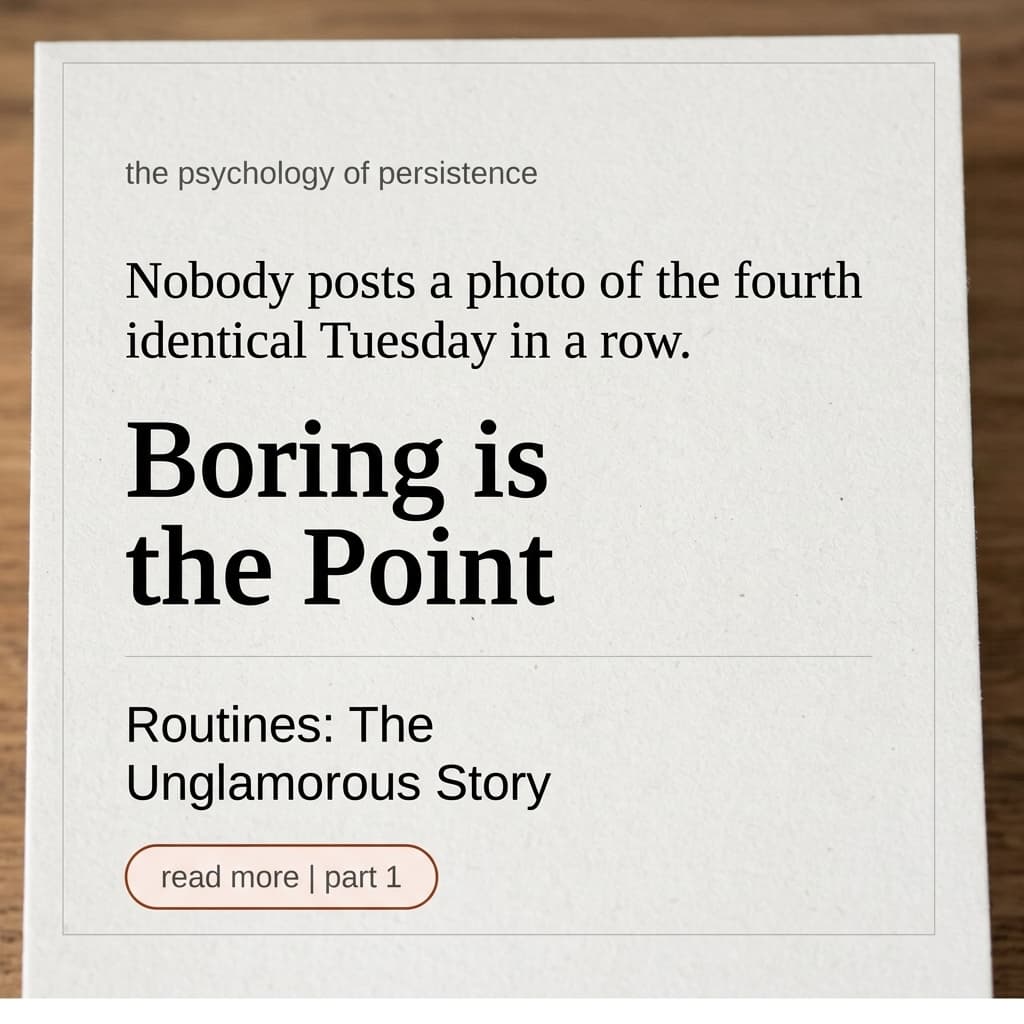
Nobody posts a photo of the fourth identical Tuesday in a row.
We love the story of the breakthrough: the late-night idea, the sudden burst of motivation, the day everything changed. We don't love the story of the person who did the same unglamorous thing at the same time for eleven months. But that second person is usually the one who got somewhere.
I used to be a motivation chaser. I'd wait until I felt inspired, then work hard for a few days, then disappear for two weeks. I called it "having a creative process." Looking back, it was mostly waiting.
Inspiration is a terrible employee
Inspiration shows up late, leaves early, and never gives notice. If your progress depends on it, your progress depends on your mood, the weather, how well you slept, and whether someone upset you that morning.
A routine doesn't care about any of that. It asks one question: did you show up? That's a much easier standard to meet than "did you feel like it?"
The best work I've done wasn't done in a flash. It was done on days when I opened the laptop with no energy, did an hour anyway, and was surprised afterwards by how much I'd moved.
Boring is the point
A good routine should feel almost embarrassingly plain: the same time, the same place, the same first step. That plainness is what makes it work.
When you don't have to decide when to start, where to work, or what to do first, you save your willpower for the thing that matters. Every decision you remove is a small piece of friction gone. People who seem "naturally disciplined" have often just made most of their decisions in advance.
It's a bit like good code. Nobody admires the function that does the same dull job reliably ten thousand times a day, but everything else depends on it.
The part nobody tells you
Routines feel pointless for a long time. For the first weeks, nothing visibly changes. You show up, you do the work, and the result looks small. That's the stage where most people quit, because the effort and the evidence don't match yet.
Then at some point you look back and find that the small things added up. [ADD YOUR OWN EXAMPLE HERE]
What a routine gives you that motivation can't
- Calm. You stop negotiating with yourself every morning.
- Momentum. Starting is the hardest part, and a routine makes starting automatic.
- Freedom. It sounds backwards, but structure in the boring parts of life is what leaves room for the interesting ones.
- Trust in yourself. Each time you show up when you didn't feel like it, you build proof that you can rely on yourself.
"But won't I get bored?"
Yes, sometimes. Boredom is part of the deal, and it's not a sign that something is wrong. It's usually the point where the habit is moving from exciting to ordinary, which is exactly where it starts to hold.
You also don't need a perfect routine. You need a small one you can keep. Ten minutes done daily beats two hours done once. A routine should fit the life you actually have, not the one you imagine on a good Sunday.
Start smaller than feels respectable
If you want to try this, pick one thing and make it almost too easy. Same time, same place, a tiny first step. Do it for two weeks without judging the results. Don't add anything until the first thing feels normal.
It won't make for a good story while it's happening. That's fine. The story gets told later, in the results.
So here's my case, plainly: most of what we admire in other people was built on days that looked boring. Choose a few boring things worth doing, and then do it again tomorrow.
Have a Project in Mind?
If you have questions about this topic or want to collaborate on a project, don't hesitate to reach out.
Let's CollaborateYou May Also Be Interested In
Continue exploring more insights and tutorials.